 Feedback Journey
Feedback Journey vs. Trustpilot
Trustpilot is a public review platform built to prove a company is reputable. Feedback Journey is built to prove an individual delivers — it's the specialized alternative for IT consultants, freelance developers, and agencies who collect invited client feedback and turn it into marketing material. Trustpilot rates the brand; Feedback Journey gives you comparable, verifiable, personal proof you own. Free to start, €67 a year.
The short version
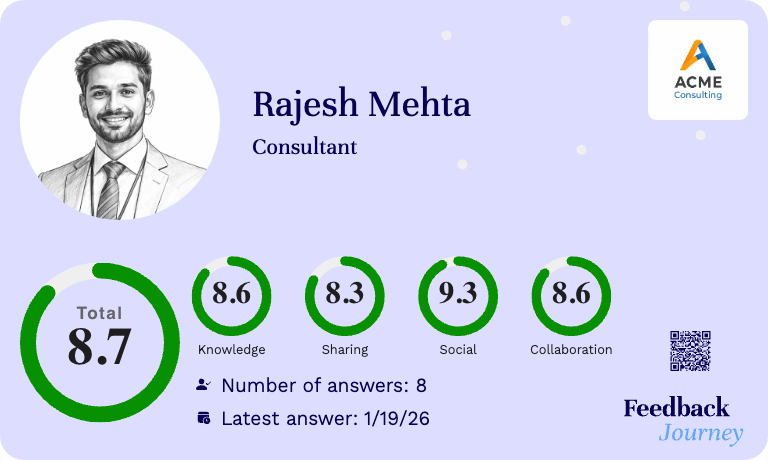
Trustpilot is one of the best public review platforms in the world. If you're a consumer-facing business that wants open reviews, trust badges, and reputation SEO at company scale, use it. But if you're a consultant or freelancer who needs to prove the value you personally delivered on each engagement, a company-level star average can't do that. Feedback Journey collects invited, comparable feedback from your real clients and turns it into a QR-verifiable Journey Card — proof about you, owned by you.
Feedback Journey vs. Trustpilot, side by side
| What matters to a consultant | Feedback Journey | Trustpilot |
|---|---|---|
| Built for | Consultants, freelancers & knowledge workers proving personal client satisfaction | Companies & brands building public reputation with consumers |
| What's rated | The individual's work on each engagement | The company as a whole — one public brand score |
| Who can respond | Invited feedback from the actual clients you worked with | Anyone public who claims to be a customer |
| Questions | Fixed, expert-designed sets per survey type — comparable across projects and people | Free-text review plus a star rating; no comparable structure |
| Comparability | An 8.4 means the same thing everywhere — across surveys, people and companies | Star averages aren't comparable between individuals or projects |
| Shareable proof | QR-verifiable Journey Card, anti-cherry-picking, about you | A public company profile and trust badges — about the brand |
| Improvement | Improvement Goals turn feedback into a tracked growth cycle | Reviews sit on a public profile; no personal growth loop |
| Honest scores | Responders are nudged away from inflated 10s, so scores stay meaningful | Public star reviews skew to the extremes — five stars or one |
| Data ownership | You own your data and choose when and with whom to share it | Reviews live on Trustpilot's public profile for the company |
| Pricing | Flat and freelancer-friendly — free to start, €67 a year | Business plans priced per company for reputation features |
Why a public review site falls short for individual proof
A public brand-review platform is a strength for consumer reputation and a weakness for personal proof. Trustpilot rates the company, not the consultant a client is about to hire, so a great company average says nothing about the individual — and reviews are public, open to anyone, and free-text, so there's no comparable structure to reason about. There's no growth loop for a person either: reviews accumulate on a public profile, and turning them into deliberate improvement is on you. And the reviews live on Trustpilot's domain, tied to the brand — not something an individual can carry to the next engagement as their own verifiable proof.
What Feedback Journey adds on top
- Proof about you, not the brand. Invited feedback from your real clients becomes evidence of what you delivered — the thing a company-level score can never show.
- Comparable data by design. Fixed question sets per survey type mean an 8.4 means the same thing across projects, people, and companies — the foundation everything else is built on.
- A verifiable Journey Card. Your results become a QR-checkable card that covers a range of surveys and can't be cherry-picked, so clients can confirm them online without creating an account.
- Improvement Goals. Turn any weak spot into a concrete goal and track it across the next surveys, so your scores climb on purpose rather than by luck.
- Honest scoring. Responders are actively discouraged from inflating scores (a 10 is world-class only), which is what makes the numbers mean something — unlike public reviews that cluster at the extremes.
- You own your data. Your results are yours to share when, and with whom, you choose — not published to a brand's public profile.
When Trustpilot is still the right tool
This isn't a takedown. Trustpilot is excellent at what it's for: public, consumer-facing reputation for companies and brands — e-commerce shops, SaaS products, and service businesses that want open reviews, trust badges, and reputation SEO. Feedback Journey doesn't try to replace that. It replaces the narrow, recurring loop where an individual knowledge worker collects client feedback and needs comparable, verifiable, personal proof — a job a public company-review site was never designed to do.
What does Feedback Journey cost?
Flat and simple: free to start with no credit card, then €67 a year for unlimited surveys, respondents, Improvement Goals, and Journey Cards. For most consultants that's less than a single billable hour, and you can test it on a real client before you pay anything. Here are the plans:
What does Feedback Journey cost?
Feedback Journey costs nothing to start and €67 per year for one person. A whole organization is €1,500 per year, with no charge per seat. Every plan includes all three survey types, so pick the one that fits you today and upgrade whenever you need to.
Free Trial
Free
No credit card required.
- Up to 3 surveys
- Up to 5 invited respondents
- Access to all survey types
Single User
€67 per year
Or pay €24 every three months.
- Unlimited surveys
- Unlimited respondents
- Improvement goals & Journey cards
Organization
€1,500 per year
One price for your whole team.
- Everything in Single User
- Organization-wide dashboard
- Department management
- Role-based access control
All prices exclude VAT. We bill through Stripe.
An organization can invite every colleague without the price going up. That keeps the cost predictable however fast the team grows.
Feedback Journey vs. Trustpilot — FAQ
Try it on your next project
Create your first survey in a few minutes — free, no credit card required — and see your Journey Card before you decide.