How do you get honest feedback from the whole client team?
Ask the people who work next to your consultant every day, not only the client’s manager. A guide for consulting firms, with a short video.
Ask the people who work next to your consultant every day, not only the manager who bought the assignment. Use a short survey with the same questions every time, and let the consultant decide who sees the results. The manager gives you one view. The team gives you the full picture.
In the video, André runs a small consulting firm. He meets the client’s manager, asks how his consultant is doing and gets a friendly answer. He nods. Afterwards he realises that he has never heard from the people who sit next to the consultant every day.
Why is the client’s manager not enough?
Because the manager sees results, while the team sees the work. A manager knows whether deadlines are met and the budget holds. They rarely see who answers questions in the corridor, who explains a tricky part of the system, or who makes a stand-up meeting easier.
Quiet consultants lose the most from this. They do solid work, help others and never make noise about it. The manager says “fine”, and “fine” is all the consulting firm ever hears. The value they add to the team stays invisible, both to their own manager and to the client.
One person’s view is also fragile. A single meeting, a bad week or a personal preference can colour it. Several answers from the team even that out.
What should the client team be asked?
Ask about the things only colleagues can see. Knowledge, how it is shared, the effect on the work environment and collaboration. Keep it short, so people actually answer.
Feedback Journey’s Long term survey is made for assignments that run over several months, where the consultant works with the client, often at their location. It has four fixed questions, each scored from 0 to 10, and a field for a comment.
- Knowledge. The consultant’s professional skills, compared to what was promised.
- Knowledge sharing. How well the consultant shares knowledge and experience to help solve the team’s needs.
- Social. What the consultant contributes to the working environment.
- Collaboration. How easy the consultant is to work with, within the team and between teams.
Because the questions are fixed, every round can be compared with the last one, and one consultant’s results mean the same as another’s.
How do you get colleagues at the client to answer?
Make it short, explain why you ask and send it at a calm moment. People answer when they know it takes a minute and that their answer will be used. They skip a request that looks like one more form.
Ask the client’s manager first, so the team knows the survey is welcome. Then let the consultant send it, with a line in their own words. “I would value your view on how I work with the team. It takes about a minute.” A request from the person it concerns feels more personal than one from the firm.
Choose the timing with care. The end of a sprint or a quiet week works better than the day before a release. Say when you will ask again, so the colleagues see it as a habit and not as a test. Honest answers come more easily when nobody fears a single score will decide anything.
Who should see the results?
The consultant decides. In Feedback Journey, the person who owns a survey chooses who gets access to it. That keeps the feedback personal, and it makes it more likely that the consultant will ask for it again.
In the video, the consultant chooses to share his results with André. That turns the survey from a grade into a tool. André can read the scores and the comments with him, and use them to talk about what to keep and what to work on.
Feedback that the consultant owns feels very different from feedback collected about them. The first invites growth. The second invites defence.
What do you do with the answers?
Pick one category to improve, set a goal and ask again later. In the video, the results come from seven answers. Knowledge is 8.6, Knowledge sharing 7.8, Social 7.0 and Collaboration 8.0. These are good numbers, with one clear place to start.
André helps the consultant set an improvement goal. In Feedback Journey, a goal is created from a completed survey, for the categories you choose, with a plan. A supporter, such as a manager, can help along the way, and comments on the survey can be used for coaching and reflection. New surveys then show how the chosen categories develop.
To improve the Social score in particular, read how to improve your influence on the work environment.
How do you share the team’s view with the client?
Bring it to your next meeting with the client’s manager, with the consultant’s consent. In the video, André goes back and says, “This is what your people think about my consultant.”
That one sentence changes the conversation. The manager now hears from their own team, not only from the firm selling the service. It shows that the consulting firm cares about how its people work day to day, and not only about renewing the contract.
It also gives the manager something they rarely have, a structured view of how an outside consultant fits into their team. Many managers will find that useful in its own right.
What should you avoid when you ask the client team?
- Asking only the people you already know. Ask everyone who works closely with the consultant, including the quiet ones.
- Sharing results without consent. Let the consultant choose who sees them.
- Long, custom forms. Busy colleagues answer a short survey. They skip a long one.
- Asking once and never again. One round is a snapshot. Several rounds show a direction.
For more on who to ask inside a client organisation and when, read best practices for collecting feedback from business clients.
What happens in the video?
The video is under a minute long. The text on screen tells the story, so it works without sound. The people in it are fictional, and the video is AI-generated. Here it is as text, in the order it plays.
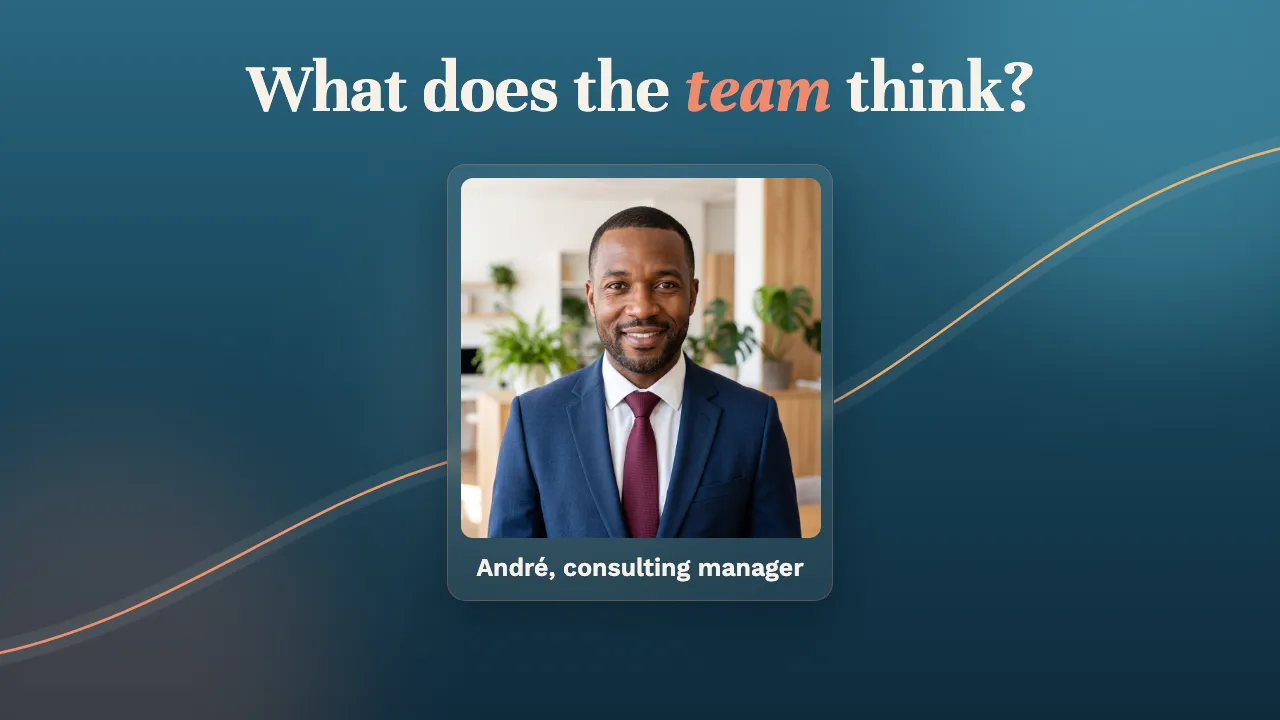
- Title card. “What does the team think?” André, a consulting manager, is introduced.
- Only the manager. On screen, “André only asks the client’s manager.” André listens to the manager at the client and nods.
- The people who are never asked. On screen, “The people next to the consultant are never asked.” André sits alone after the meeting and thinks.
- The results. An example results card, labelled “Example”, shows a Long term survey with Knowledge 8.6, Knowledge sharing 7.8, Social 7.0 and Collaboration 8.0, from 7 answers. On screen, “Collaboration 8, Social 7.”
- The goal. On screen, “André helps him set an improvement goal.” André talks with the consultant, who is seen from behind.
- Why ask the whole team?. An infographic shows three steps. His colleagues at the client answer. Four scores and a comment, on Knowledge, Knowledge sharing, Social and Collaboration. He shares the results and sets a goal.
- The whole team is heard. On screen, “Now the whole team is heard.” André meets the client’s manager again and says, “This is what your people think about my consultant.”
- End card. “Show your client what their own team thinks.” The card shows feedbackjourney.com and the note “AI-generated. Fictional characters.”
Frequently asked questions
Try it with your next client
Create your first client survey in the Feedback Journey app, or read more guides on collecting honest feedback.